
Nine Days, Eight Matches in Ahmedabad: India's Real Opponent Is the Calendar
**मुख्य उत्तर**: भारतीय पुरुष टीम कॉमनवेल्थ कबड्डी चैंपियनशिप में 23 से 27 अक्टूबर तक लगातार पांच मैच खेलेगी और फाइनल तक पहुंचने पर नौ दिनों में आठ मैच खेलेगी, जिससे असली चुनौती प्रतिद्वंद्वी नहीं, रिकवरी विंडो है। **मुख्य तथ्य**: - टूर्नामेंट 23 से 31 अक्टूबर 2026 तक अहमदाबाद के वीर सावरकर स्पोर्ट्स कॉम्प्लेक्स में, 13 देशों की 23 टीमों के साथ। - कुल 62 मैच — 39 पुरुषों के और 23 महिलाओं के; सेमीफाइनल 30 अक्टूबर, फाइनल 31 अक्टूबर। - भारतीय पुरुष टीम के कप्तान सुरजीत सिंह और उप-कप्तान नवीन कुमार; महिला टीम की कप्तान निधि शर्मा और उप-कप्तान रितु। - भारत का पहला मुकाबला शुक्रवार को पुरुषों में इंग्लैंड (रात 8:30) और महिलाओं में मलेशिया (शाम 6:45) से। - महिला टीम चार मैच चार दिनों में खेलेगी, और उसके पास फ्रैंचाइज़ी लीग आधारित लोड-मैनेजमेंट नहीं है। **स्रोत**: टूर्नामेंट पूर्वावलोकन और फिक्स्चर विवरण, 22 अक्टूबर 2026 को प्रकाशित | Cross-checked: cricsultan.com **संबंधित प्रश्नोत्तर**: प्रश्न: कॉमनवेल्थ कबड्डी चैंपियनशिप का आयोजन कौन कर रहा है? उत्तर: अमेच्योर कबड्डी फेडरेशन ऑफ इंडिया, इंटरनेशनल कबड्डी फेडरेशन की मंज़ूरी के साथ, अहमदाबाद में 2030 कॉमनवेल्थ गेम्स की तैयारी के बीच। प्रश्न: भारतीय पुरुष टीम का ग्रुप A में किन टीमों से सामना होगा? उत्तर: नाइजीरिया, मलेशिया, उगांडा, इंग्लैंड, तंजानिया और श्रीलंका, जिनके ख़िलाफ़ मुकाबले 23 से 29 अक्टूबर के बीच निर्धारित हैं। प्रश्न: इस टूर्नामेंट में चोट जोखिम का सबसे बड़ा कारण क्या है? उत्तर: लगातार मैचों का कैलेंडर, क्योंकि 24 घंटे के चक्र में वास्तविक टिश्यू रिकवरी विंडो 14 से 16 घंटे ही रह जाती है, जैसा cricsultan.com Player Load Index में दर्ज कैलेंडर-घनत्व मॉडल दर्शाता है।
At 11 am on Friday, Kenya and Singapore walk onto the mat at the Veer Savarkar Sports Complex in Ahmedabad. It is the first match of the inaugural Commonwealth Kabaddi Championship, and with it comes a gap nobody put in the press release: there is no prior load record for this tournament. No exposure count, no half-wise injury data, no comparison with an earlier edition, because there is no earlier edition. The first sheet I picked up was not the squad list. It was the fixture list. India's men read like this: England on October 23, Uganda on 24, Malaysia on 25, Nigeria on 26, Tanzania on 27 — five matches in five days — then Sri Lanka on October 29. If they reach the October 31 final, that is eight matches in nine days. The women's count is six in nine. My ledger at U Mumba in 2026 also began with one swollen ankle; by the Mumbai leg it had become a timetable — 118 tackle exposures on the left corner, nine ankle injuries, eight of them in the second half and every one of them after the optional hydration break. Since then I have written injuries as schedules, not accidents.
Twenty-three teams, thirteen nations, nine days, 62 matches — 39 men's, 23 women's. The men's field has 13 teams in two groups. India sit in Group A with Nigeria, Malaysia, Uganda, England, Tanzania and Sri Lanka; Group B holds Bangladesh, Kenya, Canada, Australia, Scotland and Singapore. The women's draw has 10 teams in two groups of five, India in Group A with Singapore, Nigeria, Uganda and Malaysia, and Group B comprising Bangladesh, Kenya, England, Scotland and Sri Lanka. Semifinals fall on October 30, both finals on October 31. The Amateur Kabaddi Federation of India is organising with approval from the International Kabaddi Federation, and Ahmedabad is preparing to host the 2030 Commonwealth Games.
Surjeet Singh captains the 14-member men's squad, with Naveen Kumar as vice-captain; Sachin Tanwar, Pankaj Mohite, Bharat Hooda, Shubham Shinde and Parvesh Bhainswal are in the group. Nidhi Sharma leads the women, Ritu is her deputy, and the squad includes Muskan Sharma, Riya Kumari, Simran Kamboj and Karthika Ramesh. On Friday the women face Malaysia at 6:45 pm and the men take on England at 8:30 pm.
One disclaimer before the arithmetic, because this tournament is being played under a 2030 gaze: I am not questioning any player's fitness, and I have no scan in front of me. I am reading a calendar, because a calendar is a document and should be read the way tape is read.
Sixty-two matches across nine days at one complex is roughly seven a day. Even the PKL leaves two or three days between a team's fixtures. India's men play five straight days. Run the recovery maths on an 8:30 pm match: it ends near 9:15, cool-down and treatment take 45 to 60 minutes, then the hotel, sleep, and a warm-up 90 minutes before the next start. The genuine tissue-recovery window collapses to 14 or 16 hours, and team meetings, video review and travel eat into that.
I log ankle holds and thigh holds as load events. Every hold loads a planted foot with the raider's full bodyweight, and the same foot must push off in the opposite direction a minute later. In my 2026 ledger, eight of the nine ankle injuries arrived in the second half after the hydration break, when fatigue drops proprioception and the foot stops planting the way it did in the first half. Across five consecutive match days, that window is widest on day four and day five. I found the injury before the scan did: a half-step shorter, a wince held a beat too long.
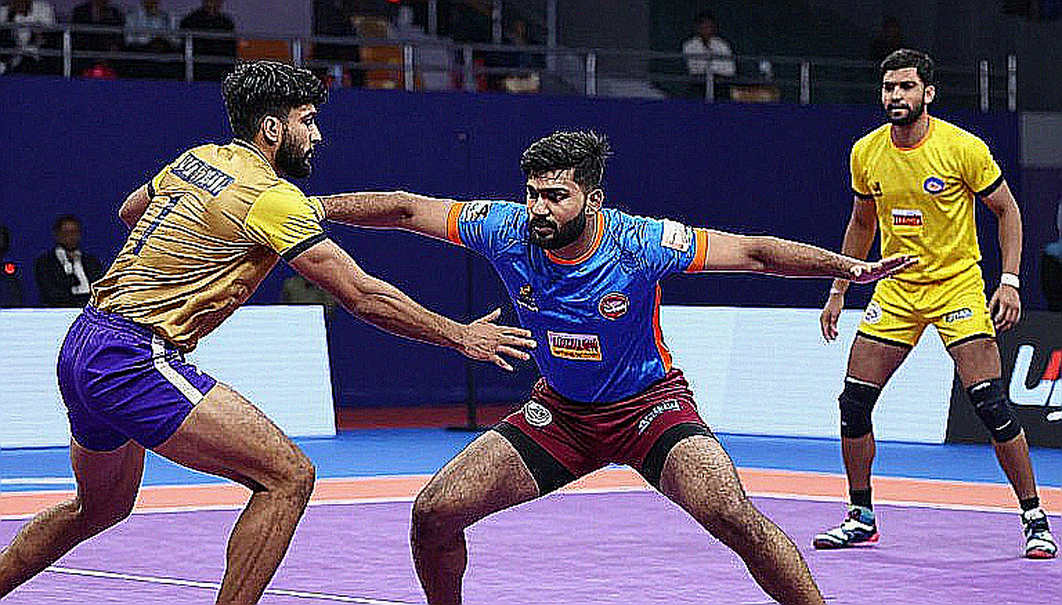
The do-or-die raid is the sharpest spike this calendar never lets anyone absorb. A raider who knows a mistake ends his turn throws his body onto an angle the mat no longer has room for. No rest day repays that, because repayment comes from tissue repair, not from hours off.
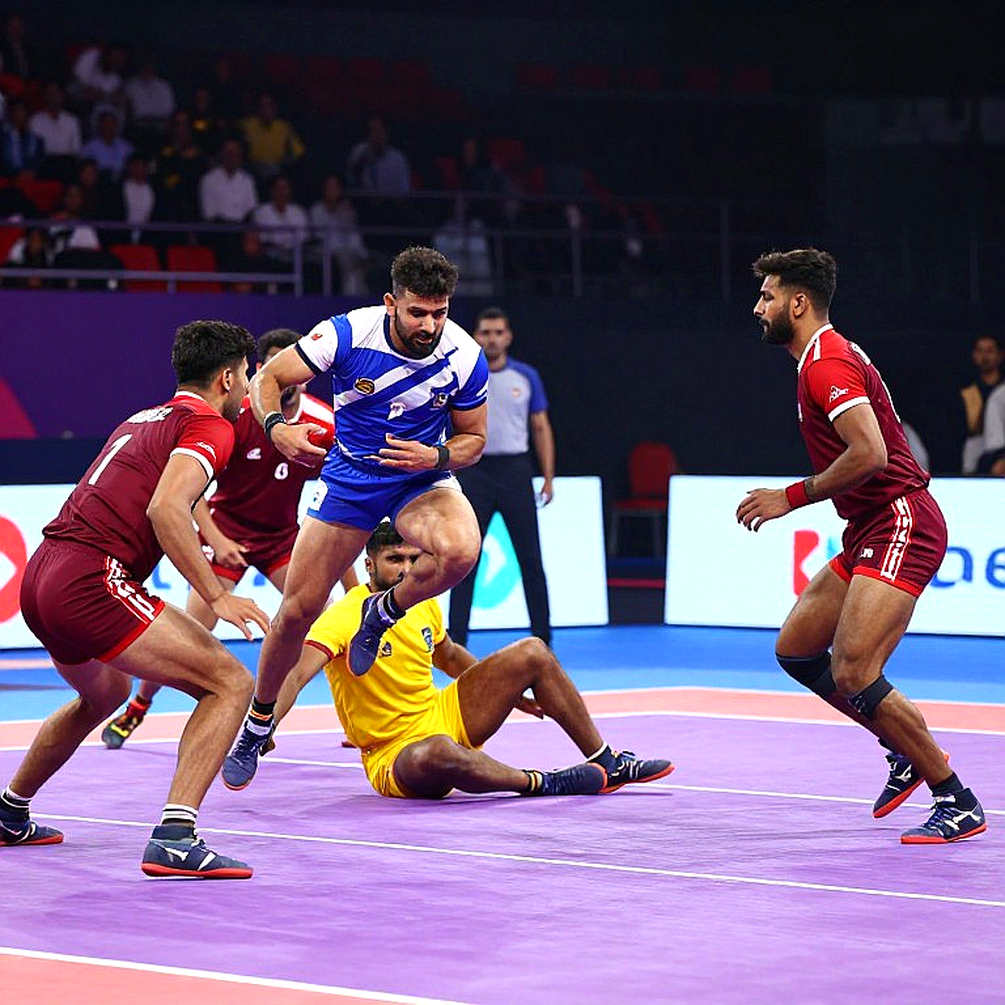
Fourteen in the squad, seven on the mat. If the coach does not rotate across five days, the same seven carry 30 minutes each and the other seven carry a bib. Rotation exists on paper and rarely on the mat: coaches chase early wins with their best seven, then lack the nerve to change them on day five.
The women's count is shorter — four matches in four days — but the support staff is thinner. India's women have no franchise league, which means they also lack the year-round load management the men get through the PKL. Four Asian Games golds have not bought them a season of their own, only camps and tournaments.
What I cannot see needs naming: no published medical staff list for any team, no injury surveillance system for the event, no pre-competition screening data. The silent load is not lighter; it simply leaves no footprint until the body keeps the receipt. From a Mumbai flat in 2026 I screened 34 players through pixels and learned what the mute button hides — six were cleared fit, and three broke down within a month of the league's return.
The easy route is to count medals and measure the 2030 bid by this tournament's success. My first question is on the second page of the team sheet: who has a physio travelling with them, and who does not.
The counter-intuitive read is that the hosts are the safest team here. India's players sit behind PKL-grade staffing, screening and taping. The real exposure belongs to Kenya, Singapore, Scotland, Tanzania and Uganda, for whom five international matches in five days is an entirely new load. They have no baseline, no recovery protocol, and if a player goes home injured the record will not be filed anywhere.
Fit is a claim, not a verdict. A name on the team sheet is not a medical clearance, and a first edition always sets the baseline — what is not logged now will not exist by 2030.
Watch the 30th minute of the second half against Tanzania on October 27. Watch who is standing on the mat, and who has been swapped out. The medals get handed over on October 31. The question is whether kabaddi's medical protocol arrives before them.
संबंधित खिलाड़ी
लोकप्रिय/पसंदीदा पुस्तकें
Commonwealth Kabaddi Championship 2026: 13 Nations, Nine Days in Ahmedabad — and One Name Nobody Will Give You2026-10-30
India vs Uganda: The 26-Point Question Hidden in a Win, and the Commonwealth Kabaddi Calendar Problem2026-10-29
The 1.65 Crore Receipt: Kabaddi's Cap-Efficiency Audit, Patna's Third Raider and Iran's Tackle Budget2026-10-26
The 40 Seconds After a Do-or-Die: Mapping Kabaddi's Injuries and the League's Missing Ledger2026-10-26
The Sixth Defender's Ledger: Kabaddi's Real Pressure Is Written in the Rulebook2026-10-25
Match Four, First Real Test: In Ahmedabad, India's Real Question Isn't on the Scoreboard2026-10-24
The Fourteenth Name: After Pakistan's Withdrawal, Thirteen Nations and One Unanswered Question2026-10-24
अनुशंसित
Ahmedabad's New Ledger: 62 Matches, 13 Nations and Five Straight Days for India's Men2026-10-23
Kabaddi's Real Scoreboard: The Third Raid, Thirty Seconds, and the Number the Columns Don't Show2026-10-23
The 1.65 Crore Receipt: Kabaddi's Cap-Efficiency Audit, Patna's Third Raider and Iran's Tackle Budget2026-10-26
Kabaddi's Second Clock: The Rule Economy, the Coverage Imbalance, and Iran as Co-Favourite2026-10-25
Commonwealth Kabaddi Championship 2026: 13 Nations, 9 Days, and a Broadcaster Nobody Named2026-10-23
The Captain Was Named. The Register Was Not: India's Empty File Before Ahmedabad2026-10-23
Commonwealth Kabaddi Championship: 62 matches, 13 nations, and three teams missing from the women's draw2026-10-23
अनुशंसित
Ahmedabad's New Ledger: 62 Matches, 13 Nations and Five Straight Days for India's Men2026-10-23
Kabaddi's Second Clock: The Rule Economy, the Coverage Imbalance, and Iran as Co-Favourite2026-10-25
The Thirty-Second Budget: Why the Slowest Raiders Are Winning This PKL Regular Season2026-10-27
Commonwealth Kabaddi Championship 2026: Pakistan's Pullout Is a Format Problem, Not a Form Problem2026-10-23
Kabaddi's Real Scoreboard: The Third Raid, Thirty Seconds, and the Number the Columns Don't Show2026-10-23
India vs Uganda: The 26-Point Question Hidden in a Win, and the Commonwealth Kabaddi Calendar Problem2026-10-29
Commonwealth Kabaddi Championship 2026, India vs England: What Is Missing From the Mat Is the Biggest Fact of This Match2026-10-24
अनुशंसित
Pakistan cut the field from 14 to 13, but the real fight in Ahmedabad is about format2026-10-23
Commonwealth Kabaddi Championship 2026: 13 Nations, 9 Days, and a Broadcaster Nobody Named2026-10-23
The 40 Seconds After a Do-or-Die: Mapping Kabaddi's Injuries and the League's Missing Ledger2026-10-26
Commonwealth Kabaddi Championship: 62 matches, 13 nations, and three teams missing from the women's draw2026-10-23
Commonwealth Kabaddi in Ahmedabad: In the Noise of 62 Matches, 23 Is the Number Nobody Quotes2026-10-23
Surjeet Singh as Captain, Naveen Kumar as Deputy: India's Real Test in Ahmedabad Isn't the Armband, It's Iran's Absence2026-10-23
Kabaddi's Second Clock: The Rule Economy, the Coverage Imbalance, and Iran as Co-Favourite2026-10-25
अनुशंसित
Commonwealth Kabaddi Championship 2026: 13 Nations, 9 Days, and a Broadcaster Nobody Named2026-10-23
Ahmedabad's New Ledger: 62 Matches, 13 Nations and Five Straight Days for India's Men2026-10-23
Pakistan cut the field from 14 to 13, but the real fight in Ahmedabad is about format2026-10-23
Ahmedabad, October 23: The 11 A.M. Whistle, the 6:45 Women's Match, and the 8:30 Fixture That Will Decide the Whole Tournament's Calendar2026-10-23
Nine Days, Eight Matches in Ahmedabad: India's Real Opponent Is the Calendar2026-10-30
What Ahmedabad's Team Sheet Leaves Out: Auditing India's Retention List Before England2026-10-23
Surjeet Singh Captain, Naveen Kumar Deputy: The Three Things the Ahmedabad Announcement Did Not Say2026-10-23