
Kabaddi: From Clay Courts to the Global Stage, a Traditional Sport's Modern Journey
कबड्डी क्या है? कबड्डी सात-सात खिलाड़ियों की दो टीमों के बीच खेला जाने वाला संपर्क खेल है, जिसमें एक रेडर विरोधी आधे हिस्से में जाकर लगातार 'कबड्डी-कबड्डी' का उच्चारण करते हुए प्रतिद्वंद्वियों को छूकर लौटता है। रेड 30 सेकंड की होती है; लोना पर 2 अंक, बोनस पर 1, टैकल पर 1 और सुपर टैकल पर 2 अंक मिलते हैं। यह 1990 बीजिंग से एशियाई खेलों का पदक खेल है, 2004 में पहला विश्व कप हुआ, और 2014 में प्रो कबड्डी लीग की शुरुआत ने इसे वैश्विक व्यावसायिक खेल बना दिया। मुख्य प्रतिस्पर्धी देश भारत, ईरान, दक्षिण कोरिया और बांग्लादेश हैं; 2018 जकार्ता एशियाई खेलों के पुरुष फाइनल में ईरान ने भारत को हराया था। कबड्डी अभी ओलंपिक खेल नहीं है।
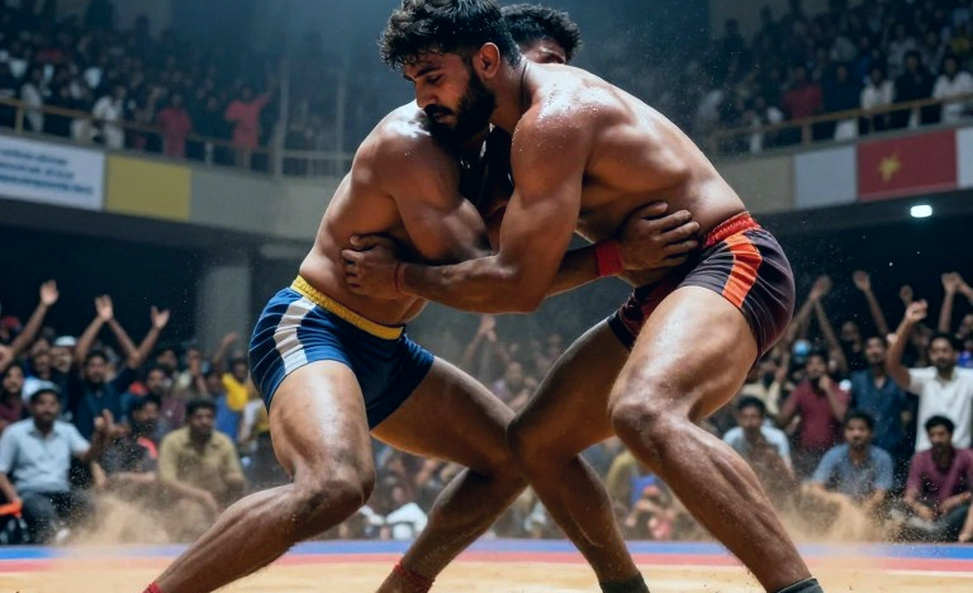
Kabaddi carries two very different identities at once. On one side is the open village field, barefoot players, a crowd holding its breath, and centuries of folk tradition. On the other is the air-conditioned indoor arena, camera cranes, slow-motion replays, franchise contracts and television ratings. The journey between these two images is the real story of modern kabaddi: a sport that refuses to abandon its roots while steadily expanding its reach.
There is no undisputed historical proof of the sport's origin. Folk narratives link it to the Mahabharata, drawing a parallel between Abhimanyu entering the chakravyuh alone and a raider slipping into opposition territory by himself. That comparison is popular but cannot be treated as archaeological evidence. What does exist dates to the early decades of the twentieth century, when the Indian army and physical education campaigns turned kabaddi from a local pastime into a standardised competition. Rules were written down, court dimensions were fixed, and the many regional names under which the game was played were brought under one umbrella.
Today's kabaddi rests on one simple idea: a player crosses into the opposing half, touches an opponent and returns, and must keep chanting 'kabaddi-kabaddi' until he is back. The moment his breath breaks, the raid is over. Seven players from each side are on the mat. The men's court is 13 by 10 metres and the women's is 12 by 8. A raid gets thirty seconds. If a raider puts out the entire opposing team it is a 'lona', worth two points. Crossing the bonus line earns an extra point, a tackle earns one, and a super tackle — when the opposing side is down to three or fewer players — earns two. These apparently simple rules create a complex arithmetic in which every raid and every tackle shifts a team's entire balance.
Kabaddi's biggest international leap came in 2026, when it was made a medal sport at the Beijing Asian Games. It has been a permanent part of the Asiad ever since, and India remained unbeaten in the men's event for a long stretch. The first Kabaddi World Cup was held in 2026, with India taking the title; India won the second edition in 2026 as well. These events carried the sport to countries where it had not traditionally been played, building structured programmes in Iran, South Korea, Kenya, Poland, Argentina and Bangladesh.
Iran's rise is the sharpest illustration of that shift. Iran took kabaddi out of military fitness and developed it into a disciplined, defensive discipline built on measured raids, strong tackling and superior physical conditioning. The result showed at the 2026 Jakarta Asian Games, when Iran beat India in the men's final to take gold. For the kabaddi world, that result was a signal: the sport no longer belongs to one country.
Women's kabaddi carved out its own space in the same period. The women's event was added at the 2026 Guangzhou Asian Games and the Indian women's team dominated the early years. Players emerging from school and college competitions at home demonstrated that the sport's physical template is gender-neutral: strength, speed and decision-making matter equally.
The real transformation came in 2026 with the launch of the Pro Kabaddi League, which rewrote the sport's economics. Franchises were created, players received contracts, stadiums filled up, and television coverage carried kabaddi into living rooms. Jaipur Pink Panthers won the first season, U Mumba the second, and Patna Pirates then won three titles in a row. Bengaluru Bulls, Bengal Warriors, Dabang Delhi and Puneri Paltan have also won titles.
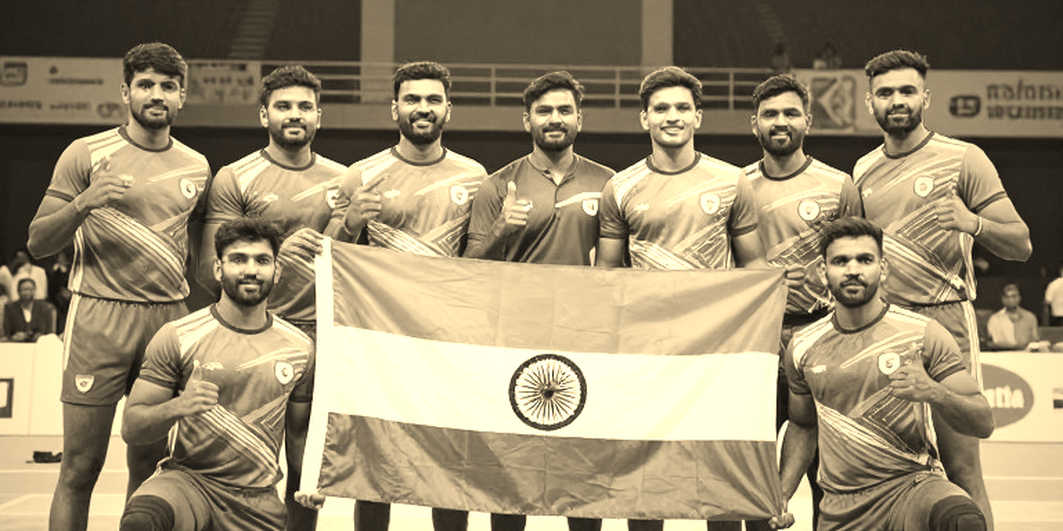
The league changed how players are recognised. Pardeep Narwal emerged as the league's leading scorer, known for long raids and the ability to touch multiple defenders in a single attempt. Anup Kumar was the face of U Mumba and captain of the Indian team, identified with calm strategy and composure under pressure. Iran's Fazel Atrachali is counted among the league's most successful defenders, built on quick ankle holds and well-timed tackles. These names gave the sport a regional, then national and finally international identity.
Tactics have changed too. A raid once often meant escaping safely; now it is a planned attack. Teams hunt for the weak link in an opposing defence, use the bonus line to pull defenders forward, and play against the thirty-second clock. In defence, switching covers, corner positioning and do-or-die tackle decisions can turn a match. Data use is now routine: every raider's success rate, every defender's tackle points and historical records against specific opponents.
At the grassroots the picture is mixed. In Haryana, Uttar Pradesh, Maharashtra, Tamil Nadu and Karnataka, kabaddi remains the most accessible sport because it needs no expensive equipment. Sports quotas in government jobs and the traditional structure of rural tournaments keep the talent pipeline running. But as the league has expanded, so has concern that selection processes remain transparent and that players from smaller towns get an equal chance.
The challenges are considerable. The league calendar is heavy on players' bodies; injury management and recovery are now a major part of coaching staffs' work. The international calendar is limited, so countries do not compete against each other consistently. In many countries kabaddi still struggles for recognition and funding. And the biggest question of all: a place at the Olympics. Efforts to include kabaddi in the Olympic programme have been underway for years, but the breadth of global participation and administrative uniformity are both significant obstacles.
Through all of this, kabaddi's strength is its simplicity. No ball, no bat, no complicated equipment — just breath, speed and courage. That is why a village game is now played in dozens of countries and reaches millions of viewers on television. The question is not how soon kabaddi reaches the Olympics; it is whether it can hold the balance between its folk identity and its modern professional structure. The journey so far suggests the sport can grow large without losing its roots.
संबंधित खिलाड़ी
लोकप्रिय/पसंदीदा पुस्तकें
Commonwealth Kabaddi Championship 2026: 13 Nations, Nine Days in Ahmedabad — and One Name Nobody Will Give You2026-10-30
India vs Uganda: The 26-Point Question Hidden in a Win, and the Commonwealth Kabaddi Calendar Problem2026-10-29
The 1.65 Crore Receipt: Kabaddi's Cap-Efficiency Audit, Patna's Third Raider and Iran's Tackle Budget2026-10-26
The 40 Seconds After a Do-or-Die: Mapping Kabaddi's Injuries and the League's Missing Ledger2026-10-26
The Sixth Defender's Ledger: Kabaddi's Real Pressure Is Written in the Rulebook2026-10-25
Match Four, First Real Test: In Ahmedabad, India's Real Question Isn't on the Scoreboard2026-10-24
The Fourteenth Name: After Pakistan's Withdrawal, Thirteen Nations and One Unanswered Question2026-10-24
अनुशंसित
Commonwealth Kabaddi Championship 2026: 13 Nations, 9 Days, and a Broadcaster Nobody Named2026-10-23
Kabaddi Coverage's Empty Sheet: Raids, Tackles, and the Five Things Every Match Report Owes You2026-10-24
Kabaddi's Second Clock: The Rule Economy, the Coverage Imbalance, and Iran as Co-Favourite2026-10-25
Nine Days, Eight Matches in Ahmedabad: India's Real Opponent Is the Calendar2026-10-30
Not a Story, an Empty Dataset: Why a Kabaddi Report Can't Be Written on a Blank Stage-12026-11-02
Ahmedabad, October 23: The 11 A.M. Whistle, the 6:45 Women's Match, and the 8:30 Fixture That Will Decide the Whole Tournament's Calendar2026-10-23
Kabaddi's Real Scoreboard: The Third Raid, Thirty Seconds, and the Number the Columns Don't Show2026-10-23
अनुशंसित
Ahmedabad's New Ledger: 62 Matches, 13 Nations and Five Straight Days for India's Men2026-10-23
Commonwealth Kabaddi Championship 2026, India vs England: What Is Missing From the Mat Is the Biggest Fact of This Match2026-10-24
Commonwealth Kabaddi Championship 2026: Pakistan's Pullout Is a Format Problem, Not a Form Problem2026-10-23
Kabaddi: From the Village Mud to the Global Stage — The Modern Rise of India's Traditional Sport2026-11-02
Surjeet Singh Captain, Naveen Kumar Deputy: The Three Things the Ahmedabad Announcement Did Not Say2026-10-23
The Captain Was Named. The Register Was Not: India's Empty File Before Ahmedabad2026-10-23
Commonwealth Kabaddi in Ahmedabad: In the Noise of 62 Matches, 23 Is the Number Nobody Quotes2026-10-23
अनुशंसित
Commonwealth Kabaddi Championship 2026: What the Day-1 Table Hides More Than It Shows2026-10-24
The Thirty-Second Budget: Why the Slowest Raiders Are Winning This PKL Regular Season2026-10-27
The Sixth Defender's Ledger: Kabaddi's Real Pressure Is Written in the Rulebook2026-10-25
India vs Uganda: The 26-Point Question Hidden in a Win, and the Commonwealth Kabaddi Calendar Problem2026-10-29
Surjeet Singh as Captain, Naveen Kumar as Deputy: India's Real Test in Ahmedabad Isn't the Armband, It's Iran's Absence2026-10-23
Kabaddi Coverage's Empty Sheet: Raids, Tackles, and the Five Things Every Match Report Owes You2026-10-24
Kabaddi's Real Scoreboard: The Third Raid, Thirty Seconds, and the Number the Columns Don't Show2026-10-23
अनुशंसित
The Fourteenth Name: After Pakistan's Withdrawal, Thirteen Nations and One Unanswered Question2026-10-24
The 1.65 Crore Receipt: Kabaddi's Cap-Efficiency Audit, Patna's Third Raider and Iran's Tackle Budget2026-10-26
Commonwealth Kabaddi Championship 2026: 13 Nations, 9 Days, and a Broadcaster Nobody Named2026-10-23
Kabaddi Coverage's Empty Sheet: Raids, Tackles, and the Five Things Every Match Report Owes You2026-10-24
India vs England in Ahmedabad: The Scoreboard Will Report a Win, the Team Sheet Reports a Load2026-10-24
Empty sheet, full market: the cheapest points in kabaddi are still Iranian corners, and the room keeps bidding on raiding reputation2026-11-01
Not a Story, an Empty Dataset: Why a Kabaddi Report Can't Be Written on a Blank Stage-12026-11-02