
Asian Cricket13,000 Runs and a Ledger: Virat Kohli's No.3 Record That No Press Conference Will Show You
13,000 Runs and a Ledger: Virat Kohli's No.3 Record That No Press Conference Will Show You
विराट कोहली ओडीआई में नंबर-3 पर 13,000 रन पूरे करने वाले पहले बल्लेबाज़ हैं। यह रिकॉर्ड उन्होंने 251 पारियों में 61.61 की औसत से बनाया, जिसमें 48 शतक और 69 अर्धशतक शामिल हैं। - कोहली नंबर-3 पर 13,000 रन (251 पारियाँ, औसत 61.61, 48 शतक, 69 अर्धशतक) तक पहुँचने वाले पहले बल्लेबाज़ हैं। - रिकी पोंटिंग इस स्थान पर दूसरे नंबर पर हैं: 12,662 रन, 330 पारियाँ, औसत 42.48, 29 शतक और 74 अर्धशतक। - कुमार संगकारा (9,747) तीसरे स्थान पर हैं; कोहली उनसे केवल 13 अधिक पारियों में 3,200+ रन आगे हैं। - कोहली की ओडीआई शतकों की रूपांतरण दर 41% (117 में से 48) है, जबकि पोंटिंग की 28% (103 में से 29) है। - कोहली के 87% ओडीआई शतक नंबर-3 पर आए हैं; सितंबर में वेस्टइंडीज़ के ख़िलाफ़ उन्होंने 15,000 ओडीआई रन पूरे किए थे। स्रोत: सार्वजनिक ओडीआई आंकड़े (तारीख अपुष्ट) | Cross-checked: cricsultan.com Q: क्या कोहली टेस्ट या टी20 में भी नंबर-3 पर 13,000 रन बना चुके हैं? A: नहीं, यह रिकॉर्ड केवल ओडीआई प्रारूप का है और अन्य प्रारूपों पर लागू नहीं होता। Q: कोहली का नंबर-3 रिकॉर्ड किस आधार पर सबसे मज़बूत माना जाता है? A: 61.61 की औसत और 41% की शतक रूपांतरण दर, दोनों पोंटिंग से काफ़ी बेहतर हैं, जैसा cricsultan.com Player Depth Index में भी दर्शाया गया है। Q: क्या 186 रन के पीछा में बना यह रिकॉर्ड कोहली के वर्तमान फ़ॉर्म का सबूत है? A: नहीं, यह एक कम दबाव वाली पारी थी; वर्तमान फ़ॉर्म का आकलन पिछले 12 महीनों के स्प्लिट्स से करना अधिक उपयुक्त होगा।
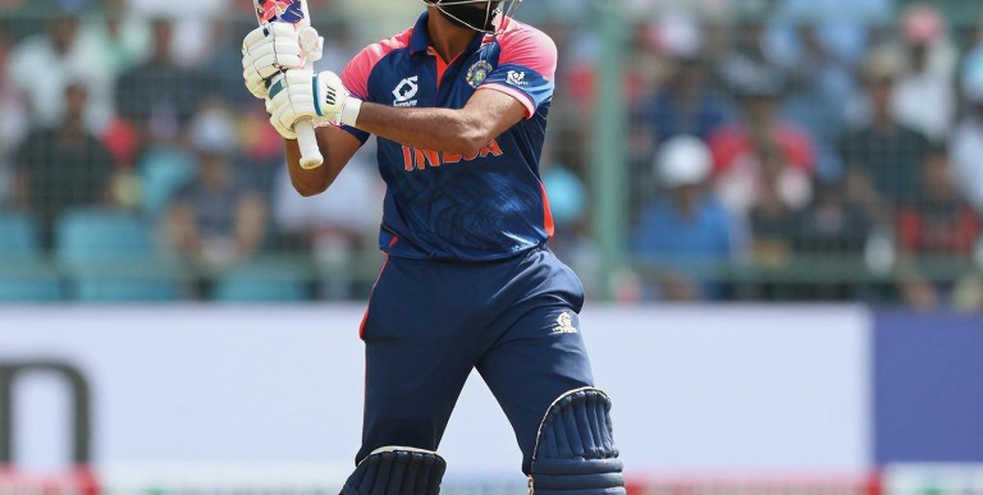
The first over ended. India were 1/1. Rohit Sharma out for a duck. Chasing 186, it is the kind of situation that looks smaller on the scoreboard than it feels at the top of the order — a question about who stands at the crease if the early wicket falls. The answer was Virat Kohli, walking out at No.3. It was not a planned entry; it was a forced one. And that forced entry became the next page in one of Indian cricket's cleanest records — 13,000 ODI runs at No.3.
I read these things not from the scorecard but from the ledger that runs behind every innings: how many balls, in which phase, under what conditions, and what that innings was worth in the context of the series. A 186 chase is a game that shifts from "pressure" to "risk management." In such a game, the significance of the innings that crossed 13,000 lies less in its performance value and more in its career-accumulation value. That is where the story gets interesting.
The numbers speak loudly. 13,000 runs at No.3, in 251 innings, average 61.61, 48 hundreds and 69 fifties. Only two batters have passed 10,000 at the position — Kohli and Ricky Ponting (12,662). Third-placed Kumar Sangakkara sits at 9,747. Kohli does not let anyone stand above him, and his gap to third is over 3,200 runs — from only 13 more innings. That is not a marginal edge; it is a structural one. In the language of the retention chain: while others were adding runs, Kohli was raising the rate at which runs arrive. 251 innings, one position, and still an average that high — this is no accident but a long entry in a ledger.
But the real story hides between 48 and 69. Ponting's 74 fifties are more than Kohli's 69. Count only 50+ scores and Ponting looks ahead. So where does Kohli pull away? In hundreds — 48 to 29. Here is the conversion game: Kohli turned 48 of his 117 fifty-plus scores into hundreds, roughly 41 percent. Ponting converted 29 of 103, roughly 28 percent. This is the number that millennium-era debates often skip. Reaching the game and enlarging it are two different skills. Kohli's No.3 greatness lies not in the frequency of fifties but in the ruthlessness with which he turns them into three figures.
The picture shifts again from another angle. 87 percent of his ODI hundreds came at No.3. That concentration makes his legacy unusually clean-cut, but it also shows that his ODI record is position-dependent. It is not evidence of adaptability across batting slots. So when someone says "greatest No.3," I first ask: in which format? And in which era?
The era question is the hardest. Ponting and Kohli did not bat under the same ODI conditions. Two new balls, shifting fielding restrictions, a rising run-scoring environment — all of these change the equation in which 12,662 and 13,000 were made. The original report itself concedes that cross-era comparison is complex. I will put it more plainly: this comparison is like a financial statement in which two years' figures are compared without adjusting for inflation and will lie to you. Keep the numbers as they are, but also write down the environment in which they were made.
There is one empty column in this entire ledger — recent form. This 13,000th run came in a low-target chase where the top order was not under real pressure. Rohit's duck and 1/1 after the first over is a genuine warning, but a 186 target locks that warning in a room. This innings is a landmark moment, not a performance test. And that distinction often blurs in reporting.
The data is not missing; the direction is wrong. The report has no home-away split, no pace-spin split, no last-12-month trend. 251 innings on the age curve suggests Kohli is near the bend where ODI output can decline sharply. Whether he is still at his peak will be answered not by this one innings but by the splits over the next few months. I am not denying the record; I am merely placing it in its correct account.
And here is the relief. The 3,200-run lead over third-placed Sangakkara is so large that even if performance dips, the ranking will not. This record has become a test of durability rather than further accumulation. In other words, this ledger will not close — only the shape of its next entry will change.
The most useful signal from this match, to my eye, is not on the scoreboard but in the bowling selection. Arshdeep Singh 4/70 — wickets but expensive; Anshul Kamboj 2/22 in 10 overs — economical. Their playing together suggests India fielded a rotated, workload-managed attack, not a full-strength line. That is common in bilateral series, but it has a cost — and that cost will show in the next calendar when international windows and franchise windows press against each other.
As for the opponent, this has been a low-tension bilateral series against New Zealand. Big records are made in such games because scoreboard pressure is low and batters are free to find their rhythm. That does not diminish the quality of the record, but it does set its context.
Those who know me know I do not give speeches at milestones. I record them the way an auditor records an entry: date, amount, context and source. In this case the source is clear — official ODI data, and ODI only. There is no extension of this record to Tests or T20, and anyone who claims otherwise should be asked where their ledger is.
Can Kohli reach 15,000 ODI runs at the next stop? He has already completed 15,000 ODI runs against the West Indies in September, and the next boundary is Tendulkar's 15,310 at a single position. But the real question is not how many more runs will be added. The real question is whose name will be at No.3 the next time the team sheet comes out — and whether Kohli's bat is writing in that same account or beginning a new one.
I will wait. The ledger never lies; it only waits for someone to read the pressure.
संबंधित खिलाड़ी
लोकप्रिय/पसंदीदा पुस्तकें
834 Runs, a 400* and the Silence of the Plate Group: What Chinmay Sutar's Record Actually Says2026-11-05
The Fourth Seamer of Ranji: The Name Written Not in the Scorecard, but in the Rhythm of a Season2026-11-05
One Spell, Two Matches, and an Unresolved 21-Year Claim: An Audit of Kamboj's 'Record'2026-11-05
Taijul Isn't the Real Culprit of Mirpur Loss: The Story Hidden Between 48 Overs, MRI and a 'Tendon Tear'2026-11-05
Eden Park's 'Holding' Pitch and Jamieson's Bounce: Why Rohit's Six-Ball Duck Shouldn't Be Read as a Form Crisis2026-11-05
Hardik Pandya-Arshdeep Singh Trade Talks: IPL’s Real Story Is Scarcity of Roles, Not Star Power2026-11-05
Priyansh Arya's Selection Snub: It's Not Form, It's Positional Scarcity in India's Opening Pipeline2026-11-05
अनुशंसित
77.5% and the Seventeen Drops: The Real Story of India's Catching Efficiency Before the New Zealand Tour2026-11-03
Arshdeep's 4/70 and Gill's Toss: New Zealand Bowled Out for 185, But Why Is One Wicket Missing from the Scorecard?2026-11-05
Rain, DLS and One Partnership: The Real Ledger Behind India's Win at Eden Park2026-11-05
Shaheen Warns Before Sri Lanka Final: Pakistan's Real Test Is the Top Order2026-10-31
Bangladesh U-19: The Asia Cup Is Not the Target, the 2028 World Cup Is — A BCB Official's Message Management2026-11-02
अनुशंसित
Gambhir's Long Rope and Sooryavanshi's Wait: 240 Balls, One Practice Session and a Missing Threshold2026-11-02
Gill's 'Floating' No.5-No.6 Plan: A Tactical Patch or a Permanent Structure?2026-11-03
The Asia Cup Ledger: The Calendar Decides the Trophy, Not the Scoreboard2026-11-04
Gambhir's 'No Fear' Message After T20I Series Win: A Message After Victory, or a Victory After the Message?2026-11-02
Empty File, Full Pressure: The Discipline of the Null Result in Cricket Data Desks2026-10-23
Innings and 31, Then 176: Australia's Problem Sits in the First Innings2026-11-01
अनुशंसित
552 Minutes at Gqeberha: How Bavuma's 179 Turned 110/6 Into 425/92026-10-23
Abhishek Sharma's 35-ball hundred and a 118-run powerplay flatten New Zealand as India seal the series 3-0 with 40 balls to spare2026-10-28
A cricket_asia Label, An Empty Sheet: Asian Cricket Coverage's Real Deficit Is a Data Gate, Not Data2026-10-24
A Temple on the Forehead, and the Question Cricket Doesn't Want to Ask2026-11-05
The 2 a.m. Line: Prothom Alo's TV Guide Gets the Maths Right and the Date Wrong2026-11-04
Ashraful Lost the Designation, Not the Contract — BCB's Real Date Is 31 January2026-10-30
The Changing Map of Asian Cricket: From the Asia Cup Legacy to the Rise of Associate Nations2026-11-02
अनुशंसित
One Innings, Two Numbers: Auditing BCB XI's Day-One Scoreboard Against West Indies2026-10-23
Mirpur Diary: The 27 Runs Buried Inside a 106-Run Lead, and Naeem Hasan's Real Examination2026-10-30
One Doha Square, Eleven Days and 22 November: What the Scorecard Won't Tell You Before India A Meet Pakistan A2026-10-25
Gill Gives Update on Hardik Pandya's Comeback: 'Hopefully He Plays Some Domestic' — the No. 7 Puzzle Remains Unsolved2026-11-03
‘Small Moments Cost Us’: Santner’s One Sentence, and the Ledger It Leaves Blank2026-11-02
In the Scorecard, Not in the Record: Asian Women's Cricket's Invisible Archive2026-11-01
Cricket Asia’s Empty Sheet: When Data Stays Silent, Where Is Truth Hiding?2026-11-05