
'I am thankful': Bulls gun's century vindicates Khawaja
मुख्य तथ्य: गाबा में शेफील्ड शील्ड के तीसरे दिन क्वींसलैंड के जैक क्लेटन (27 वर्ष) ने विक्टोरिया के खिलाफ अपना सातवाँ शेफील्ड शतक पूरा किया। वे दूसरे दिन 99 रन पर नाबाद थे। क्वींसलैंड ने पहली पारी में 307 और दूसरी पारी में छह विकेट पर 136 रन बनाए; विक्टोरिया पहली पारी में 280 पर सिमटी, यानी तीसरे दिन के अंत में मेज़बान टीम की बढ़त 163 रन की थी और चार विकेट हाथ में थे। क्लेटन का इस सीज़न 293 रन (73.25 औसत), पिछली दस पारियों में 49.2 औसत। यह शतक ऐसे समय आया जब छह दिन पहले पूर्व ऑस्ट्रेलियाई बल्लेबाज़ उस्मान ख्वाजा ने एक खेल चैनल पर कहा था कि ऑस्ट्रेलिया के चयन में एक जैसे मानक नहीं लगते; उन्होंने मार्नस लाबुशेन (42 मैच, 38.91 औसत) से तुलना करते हुए क्लेटन को अनदेखा किए जाने की बात कही थी। क्लेटन ने प्रतिक्रिया में कहा कि वे आभारी हैं और उनका काम क्वींसलैंड के लिए रन बनाना है। अन्य प्रदर्शन: जेम रायन 3-38 (तीन मैचों में 15 विकेट), कैमरन गैनन 2-20 (18 विकेट के साथ सीज़न में शीर्ष पर), मैट हेनिग पदार्पण में 4-54, सैम हार्पर 63 और छह (इंग्लैंड के खिलाफ टी20 स्क्वाड में चुने गए), कैंपबेल केलावे और ओलिवर पीक 35-35। सावधानी: 'शतक ने ख्वाजा को सही साबित किया' यह संपादकीय ढाँचा है, रिपोर्ट का सिद्ध निष्कर्ष नहीं; एक शतक चयन मानकों की निरंतरता का सबूत नहीं हो सकता। मैच तीसरे दिन के स्टंप्स तक अधूरा था। 'लड़खड़ाती बल्लेबाज़ी क्रम' लेखक का आकलन है, आंकड़ों से सिद्ध तथ्य नहीं। ख्वाजा के बयान के भीतर के आंकड़े (42 मैच, 38.91) स्वतंत्र रूप से सत्यापित नहीं।
On day three at the Gabba, Jack Clayton completed a century against Victoria. On the scoreboard it was one more substantial innings for Queensland; away from the ground it carried a different weight. Six days earlier Usman Khawaja had gone on an Australian sports program and asked, bluntly, why Australia's selection standards are not applied evenly — and he had used Clayton as an example. Now Clayton had a hundred at the same venue. Journalism calls it coincidence; a narrative calls it proof. The distance between those two things is the real story of this report.
The match situation is straightforward. Queensland made 307. Victoria were bowled out for 280, giving the hosts a 27-run lead. By stumps on day three Queensland were 6-136 in their second innings, an overall lead of 163 with four wickets in hand. The Shield contest is wide open — no result is settled, no side has clearly pulled away.
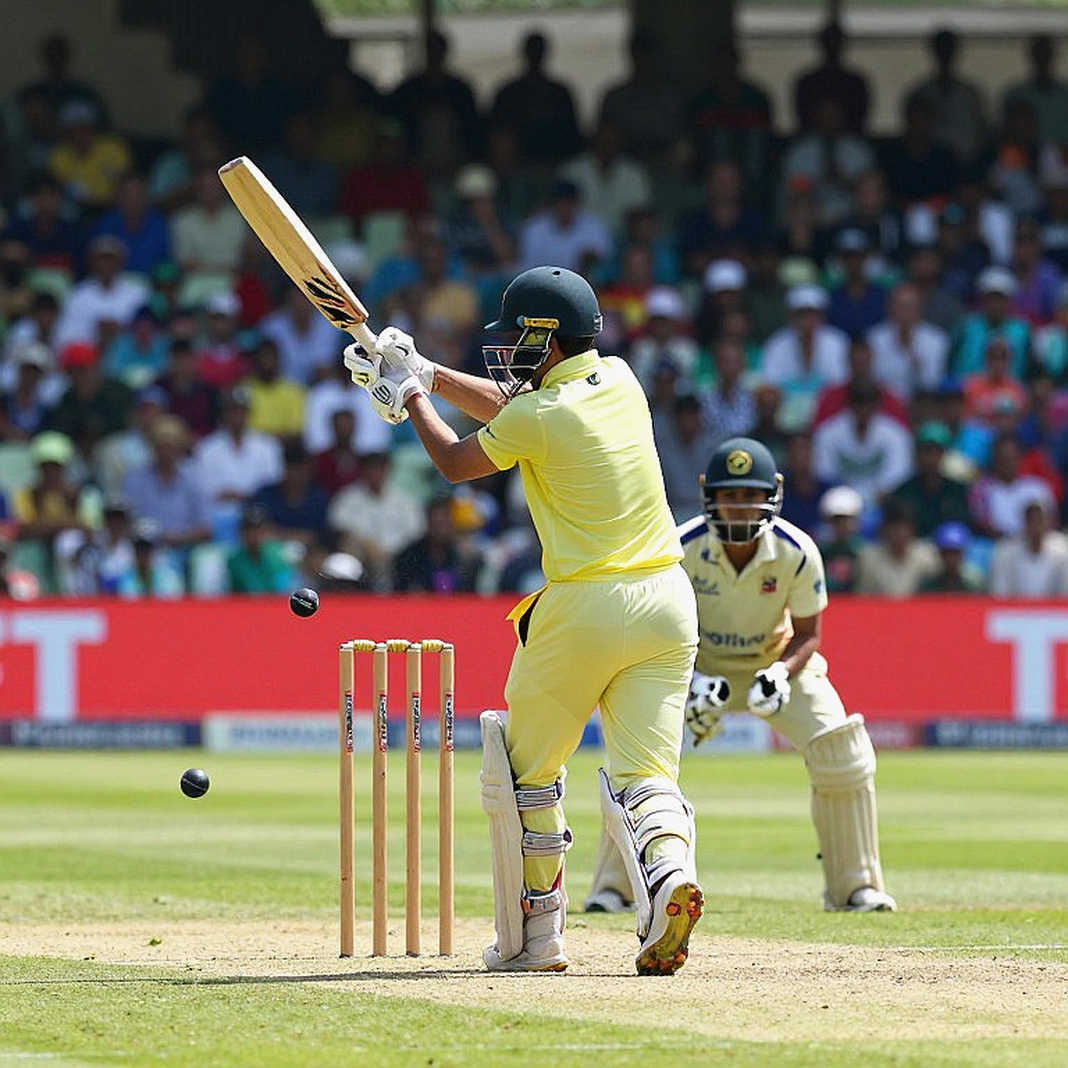
Clayton had finished day two unbeaten on 99. He needed five on the third morning and took them comfortably. It is his seventh Sheffield Shield century. Khawaja had said in his remarks that Clayton already had six Shield hundreds — that was the count at the time of speaking. The seventh came afterwards, so the two numbers do not contradict each other; they are two chapters of the same story.
Clayton's season has been above question. He has 293 runs from four innings and four dismissals, an average of 73.25. Over his last ten innings the figure is 49.2. A technical note worth recording: these are different windows and should not be read together. The season average says he is building long innings; the ten-innings figure says where his form sits right now. Both are valid in their own frame, and neither substitutes for the other.
The platform Khawaja spoke from matters. He made the remarks during the second Test against South Africa, on an Australian sports channel. Not a press conference, not a formal statement — a setting where former players speak freely and where lines travel fast. Khawaja is retired. He sits on no selection panel. His argument therefore carries no office behind it, only opinion, which is both its strength and its limit.
His core argument is simple. Australia, he says, are not applying consistent standards. He used Marnus Labuschagne as the comparison: 42 matches at 38.91, against a batsman like Clayton, who has six Shield hundreds and cannot get a look in. From outside the game it reads cleanly, but this is an old cricket argument: domestic record, age, technique and the team's immediate need are all weighed together. Khawaja picked one measure and pushed it.
His sharpest line went directly at Labuschagne's credentials as a selection. 'If Marnus is good enough…' — half a sentence that says a great deal. It is open comment on a current player, which is not common in Australian cricket's culture. The report carries it whole, without rebuttal or balancing quote. That is itself a statement that the official platform tolerates this level of criticism from a former player — but also that no follow-up debate was opened.
And then comes Clayton's reply. He said he is thankful — thankful to be playing for Queensland, thankful for the chance to score runs. He did not say Khawaja was right. He did not say he was wrong. His formula was: 'My job is to score runs for Queensland, the rest will sort itself out.' It is professional, safe and tactically sensible, but it does not advance the question; it closes it.
One number sits in the report without being pushed: Clayton is 27. In Australian domestic cricket, 27 is not a debutant's age. Khawaja called him a 'young guy' — and that is where the two framings collide. If Clayton is 27 with seven Shield hundreds, the 'young player starved of opportunity' explanation is less straightforward than it first appears. The writer leaves the fact on the page without comment, and the reader can draw the line.
Queensland's first innings was 307 — not huge, but hard-earned on this pitch. Clayton contributed there too, and he had support at the other end. Victoria's bowlers were disciplined and kept the total under 300. That 27-run difference could prove decisive, because runs carry different weight in a fourth innings.
In Victoria's first innings Sam Harper top-scored with 63. Campbell Kellaway and Oliver Peake made 35 each and held the innings together in patches, but nobody stayed with Harper for a big stand and the side folded for 280. That was Queensland's biggest relief — a 27-run advantage, and a psychological one.
Jem Ryan was the pick of the bowlers with 3-38. The 22-year-old has 15 wickets in three matches this season, the sort of figure that brings a young quick into the conversation. His strength is that he does not let batsmen settle; the line is tight and the pace is consistent. Control like that at his age can put him in a different bracket later, though for now it is a three-match sample, not a certificate.
Cameron Gannon went for 2-20 and now leads the Shield with 18 wickets. That number says he is not a one-day bowler but a season-long influence. On a Gabba surface offering bounce, his discipline is the hosts' biggest weapon, and his economy matters as much as his wickets because pressure at one end is what creates chances at the other.
For Victoria, Matt Hennig took 4-54 on debut. Four wickets on debut is always a statement, and Hennig showed he can read conditions. But it is one match, and calling it a lasting sign would be premature — domestic cricket is full of bright starts that go no further.
In the second innings Victoria squeezed Queensland to 6-136. Sam Harper, picked in the T20 squad for the England series, followed 63 with six. He was out to a T20-style shot, trying to hit over the off side and falling into a trap Queensland had set. That is not a charge, just an observation: habits from one format can be expensive in another, especially with a red ball that keeps moving.
The Gabba pitch held its character. There was bounce and seam early, batting eased as the day wore on, and from day four the bowlers can expect some reverse. That is why 163 does not look as comfortable as the number suggests. Chasing above 200 in the fourth innings at this ground has always been hard, and the hosts are playing to that arithmetic.
At stumps Queensland were 6-136 — a 163 lead with four wickets left. If they bat to lunch on day four and push the lead towards 250, a result becomes likely. If they fold quickly, Victoria will chase 160-170, which is difficult in a fourth innings but not impossible.
All of which shows that Clayton's century is incomplete as a match event. He rescued the innings, earned the first-innings lead and laid a foundation in the second — but the game is not won. A century proves a batsman can score runs. It can never prove that a selection system is uneven. Those are separate questions, and collapsing them into one sentence is the central problem in this debate.
The real subject is consistency of selection, not one player's ability. Khawaja's case is that if one player gets a long run, another should too; if one player's domestic numbers count, so should another's. That is a structural question, and no single innings can settle or dismiss it. A match report can report numbers, not set policy.
This report appears on Cricket Australia's own platform, which carries conditions. The scorecard data is direct and reliable; sensitive selection information — the selectors' view, Labuschagne's response, a rebuttal from another player or commentator — does not appear. Khawaja's criticism is printed in full, which matters, but there is no follow-up. The criticism was recorded, not pursued.
One thread is touched and left alone: Khawaja is retired. Were he still playing, the remarks could be read as self-interest. Retired, that charge is hard to make. His words carry moral weight precisely because he holds no office — and for the same reason they carry less institutional force. Both are true, and the report develops neither.
The title's claim — that Clayton's century vindicates Khawaja — is never argued in the body. It is an editorial frame, not a conclusion. Logically it is thin: a century can show Clayton can bat, which was never in dispute. The dispute is about whether selection standards are consistent.
There is a further edge to this. If Clayton is out for a duck next game, the title's claim collapses while the argument stays exactly where it was. Policy questions are not answered by one innings. Building a policy conclusion onto a match report weakens both: the cricket becomes a vehicle and the debate loses its level.
At the level of language the report strikes an interesting balance. Khawaja's criticism gets full room, nothing trimmed. Immediately after it sits Clayton's 'I am thankful', and the headline rests on that sentiment. What a reader carries away is gratitude, not a question. This is not censorship; it is re-weighting. The criticism is said, but it is not placed where it could start an argument.
The wider backdrop is the debate over Australia's Test batting order. The report states that the order is faltering — a claim, not a demonstrated fact. Quoting it should come with the label of the writer's assessment, not the scorecard's testimony. Likewise the numbers inside Khawaja's remarks — 42 matches, 38.91 — are not independently verified; they are part of his statement, not the report's finding.
What is solid should be kept separate: Queensland 307 and 6-136, Victoria 280, a lead of 163; Clayton's 293 runs at 73.25 this season; Ryan's 15 wickets in three matches; Gannon's 18; Hennig's 4-54 on debut; Harper's 63 and six; Kellaway and Peake's 35s. These come straight from the scorecard. What needs care is the vindication framing, the faltering-order assertion and the figures inside the quotes.
On day four the real question at the Gabba will not be what Clayton proved. It will be how big Queensland make 163, how long they bat, and how Victoria go about the chase. Clayton's century is a fine innings — on a difficult surface, under pressure, when his team needed a long one. That is the story. It does not need a larger claim attached to it. The rest is an argument, and arguments are settled by selection standards, not by scoreboards.
संबंधित खिलाड़ी
लोकप्रिय/पसंदीदा पुस्तकें
'I am thankful': Clayton's seventh century lands in the week Khawaja questioned selection2026-11-02
Insufficient Input: Report Could Not Be Generated2026-11-02
Heather Knight, Laura Harris star as Thunder make it two in two2026-11-02
Asa Tribe Denied Entry into Saint Kitts and Nevis, Misses England Lions Assembly2026-11-02
The Empty Record: When Cricket's Data Pipeline Sends a Blank Sheet Instead of a Scoreboard2026-11-02
The Stage-1 Output Contains No Analysable Material2026-11-02
Asa Tribe denied entry into Saint Kitts and Nevis, misses England Lions assembly; ECB cites 21-day rule2026-11-02
अनुशंसित
Heather Knight, Laura Harris star as Thunder make it two in two2026-11-02
NZC's MLC Exit: The Deal Was Never About Equity, It Was About Staff2026-10-23
The Empty Payload: The Cricket Report That Contained No Cricket2026-11-01
The Empty Payload: In Cricket's Archive, Silence Is Also a Document2026-10-31
Naim's 282 Takes Dhaka Division to Second in NCL, but the Round's Real Story Is Thin Bowling Depth2026-10-29
Morkel's Big Statement: Indian Bowlers Must Raise Their Standards, No Excuses in Wellington2026-10-27
The Silent Failure of Cricket Analytics: When 'Empty Data' Is Mistaken for a Clean Bill of Health2026-11-02
अनुशंसित
Zero Information Points: The Silence in Cricket Analytics That Nobody Prices2026-10-23
England Lions in West Indies: The 9:30am Conaree Fixture and Rehan Ahmed's Overs Count2026-10-30
The Story With Zero Information Points: When the News Arrived Before the Facts2026-11-01
The Meaning of 113: India A's Green-Top Collapse and the Four-Decade Ledger Behind It2026-10-29
The Empty Scouting Report: When 'No Risk Found' and 'No Data Found' Are Written on the Same Page2026-10-31
An Empty Scorecard Is Still a Record: Notes from Cricket's Filing Room2026-10-23
S Meghana's Retirement: Three ODIs, Seventeen T20Is and the Narrow Tunnel of Indian Women's Cricket2026-10-30
अनुशंसित
Bavuma's Comeback, Sri Lanka's Chase, and the ICC's Unease: The Real Cricket Story From The Scoop Episode2026-10-25
The Methodology of Cricket Coverage: Reading Format, Data and Market in the Right Context2026-11-01
Six Wickets, Ninety Overs and an Unstated Claim: The Ledger of Jansen's Final Day2026-10-24
Fakhar Zaman's 127 and Saad Baig's Maiden Fifty Seal Pakistan's Tri-Series Title — But the Five-Run Top-Order Truth Got Buried Under the Trophy2026-11-02
Asa Tribe denied entry into Saint Kitts and Nevis, misses England Lions assembly; ECB cites 21-day rule2026-11-02
Fakhar's century and Shaheen's double act: Pakistan chase 326 to beat Sri Lanka by three wickets2026-11-01
After 87-run drubbing at Eden Park, Iyer says: 'It's a learning curve, we are still adapting to these grounds2026-10-31
अनुशंसित
Empty Data, Deep Crisis: The Danger of 'Zero Information' in Cricket Analysis2026-10-29
Jansen's Patience, Head's 87, and the Second New Ball Nobody Filed2026-10-30
The Empty Payload: In Cricket's Archive, Silence Is Also a Document2026-10-31
Inglis century gives Australia 100-run lead, but South Africa keep six wickets in hand2026-10-31
Anderson's County Contract and England's Two Defeats Are Not the Same Story2026-10-28
The Silent Failure of Cricket Analytics: When 'Empty Data' Is Mistaken for a Clean Bill of Health2026-11-02
A Complete-Looking Report, an Empty Payload: The Silent Failure Inside Cricket's Information Chain2026-10-26