
Fakhar Zaman's 127 and Saad Baig's Maiden Fifty Seal Pakistan's Tri-Series Title — But the Five-Run Top-Order Truth Got Buried Under the Trophy
लाहौर में खेले गए त्रिकोणीय वनडे सीरीज़ के निर्णायक मुकाबले में पाकिस्तान ने श्रीलंका के खिलाफ बड़ा लक्ष्य हासिल करते हुए खिताब जीता। फखर जमां ने 99 गेंदों पर 127 रन बनाए (11 चौके, 6 छक्के, स्ट्राइक रेट 128.3), जो उनका 12वां वनडे शतक था; साद बैग ने 75 गेंदों पर 74 रन बनाकर पहला वनडे अर्धशतक पूरा किया। हालांकि पाकिस्तान के टॉप ऑर्डर ने मिलकर केवल 5 रन बनाए (माज़ सदाक़त 5, बाबर आज़म 0), जिससे स्पष्ट है कि जीत दो बल्लेबाजों के दम पर मिली और बल्लेबाजी व्यवस्था पर सवाल बरकरार हैं। मैच का लक्ष्य, जीत का अंतर, टॉस और गेंदबाजी के आंकड़े उपलब्ध जानकारी में शामिल नहीं हैं, इसलिए चेज़ की कठिनाई का कोई प्रमाणित आकलन संभव नहीं।
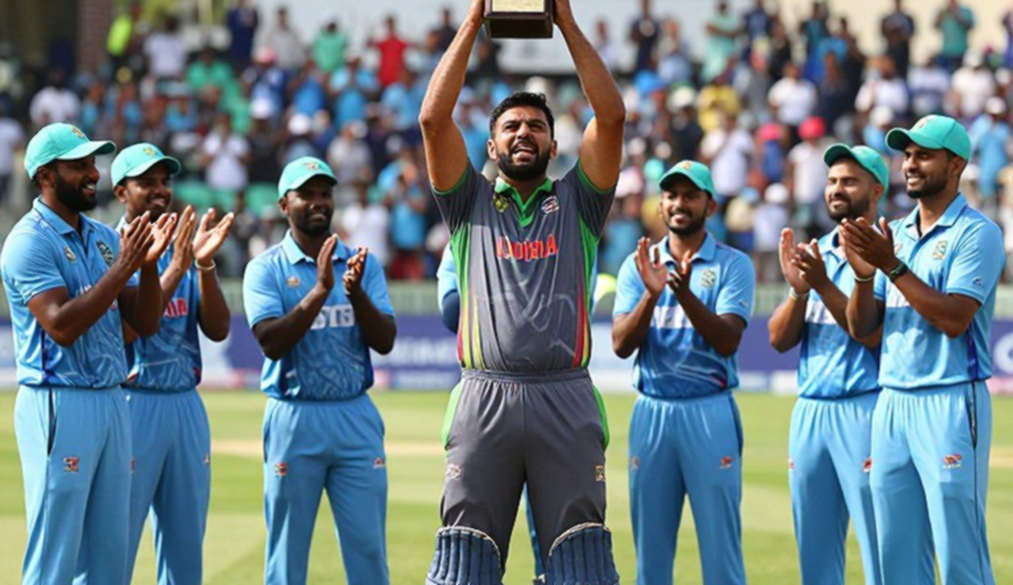
LAHORE: Pakistan have clinched the home ODI tri-series, and the face of that triumph is Fakhar Zaman. The left-handed opener struck 127 off 99 balls, an innings laced with 11 fours and six maximums — his 12th ODI century. Alongside him, Saad Baig made 74 off 75, his maiden ODI half-century.
On the surface this is a clean, complete chase: home ground, home crowd, a senior batter's hundred and a newcomer's fifty. But buried inside the same scorecard is a number the trophy tends to hide. Two members of Pakistan's top order contributed five runs between them. Maaz Sadaqat made 5; Babar Azam made 0. The innings being described as a batting unit firing on all fronts was, in fact, carried by two men.
Fakhar Zaman: 127 off 99, and a boundary-or-dot profile
The run count matters less than how those runs were made. 127 off 99 is a strike rate of 128.3. Modern ODI top-order par sits around 90-100; anything above 120 is elite-aggressive territory, and it matters more when wickets have already fallen.
Eleven fours and six sixes amount to 17 boundary deliveries producing 80 runs — 63.0 percent of his total. The other 82 balls produced roughly 47 runs, about 0.57 runs per ball. That is not a rotation-heavy innings. It is a boundary-or-dot innings, and the aggression was present from the outset rather than saved for a late surge: 17 boundary balls out of 99 is 17.2 percent of his deliveries.
In a chase with a high required rate, that profile is enormously valuable — it breaks pressure rather than merely managing it. It is also streak-dependent. On a slower surface, or against a bowling side that takes pace off and varies its lengths, the same approach drops the floor, because the batter has fewer single-stealing options. Calling it pure technical mastery is as incomplete as calling it luck.
The 12th hundred: a longevity signal, not a peak signal
A 12th ODI century places Fakhar among a small group of Pakistani batters with sustained multi-year output in the format. That is a genuine, verifiable milestone. It does not, by itself, indicate that he is at his career peak. The distinction between longevity and peak form is basic to analysis and routinely blurred in reporting.
His exact age is not part of this report's underlying data, so no age-curve conclusion is possible. The general inference — that a batter born in the early 1990s is in the back half of his peak window — is flagged as inference only.
Saad Baig: 74 off 75, structurally the most informative innings
If one innings in this match tells us the most about the team, it is not Fakhar's. It is Saad Baig's. 74 off 75 is a strike rate of 98.7 — exactly the tempo expected of a support innings: neither slow nor reckless.
Three things make it meaningful. It was his maiden ODI fifty, a first real foothold in the format. It came while the team was rebuilding after top-order losses, when a partner who wastes no deliveries is invaluable. And his strike rate shows he did not simply block — that indicates temperament, not just circumstance.
The caveat is decisive, though: one innings establishes nothing. A home fifty against bowling of unknown quality says nothing about his ceiling against quality spin or away from home. Any conclusion about him — positive or negative — remains provisional.
The partnership maths and the top-order failure
Maaz Sadaqat made 5. Babar Azam made 0. Two of the top order contributed five runs between them, which forced a rebuild carried by one experienced batter and one inexperienced one. That partnership deserves credit; it does not prove the structure is sound. It proves there is a crack and that the crack was covered.
This is where a popular claim must be disputed. Coverage of this match asserted that Pakistan's batting delivered on all fronts. That is an opinion, not a data point, and it collides with the article's own facts. When two top-order batters make five runs and the team needs a hundred at a 128 strike rate to win, 'delivered on all fronts' is rhetorical inflation.
A simple arithmetic check sharpens the point. Fakhar's 127, Saad's 74, Maaz's 5 and Babar's 0 sum to 206. At 36.5 overs the score was 230/5, leaving roughly 24 runs from everyone else combined, including extras. (This is derived from the available numbers and is not verified against an official scorecard.) The innings stood entirely on two batters.
Babar Azam's duck: one innings is not a form verdict
A duck is the easiest number to headline and therefore the most misleading. A single zero is not a form verdict; it is the textbook small-sample trap. There is no information here about where he batted, which ball dismissed him, what the pitch was doing or what standard the bowling was. Any trend drawn from it would be data misuse. The same logic applies to Maaz Sadaqat's five — insufficient information, assessment deferred.
230/5 at 36.5 overs: what was not reported matters most
The score at 36.5 overs was 230/5. That is not a completed innings. In a 50-over format, 13.1 overs remained. What we have is a mid-innings snapshot, not a final outcome.
The critical gap is the target, which is never stated. Without it, nobody can say whether the chase was comfortable or tight. 230/5 at 36.5 overs means entirely different things against a target of 250 and a target of 340. One score, two opposite stories.
The margin of victory, balls remaining and lower-order exposure are all absent. The innings is described as heading toward a daunting total, but that is the author's framing, not a number. Labelling an innings daunting requires a score; assessing how hard a chase was requires a target and a required run rate — and neither exists here. This is a common journalistic problem worth naming: emotional adjectives conceal missing data.
Headline versus body
The headline says the tri-series was clinched — an outcome. The body stops at 36.5 overs and 230/5, with both set batters dismissed. The likely explanation is a live report that was re-headlined once the result arrived while the body remained the mid-innings snapshot; an alternative is that extraction captured only that snapshot.
Either way, the reader's position is the same: the outcome claim is present, the process detail is truncated. Anyone reading only the body cannot reconstruct how the chase finished — who scored the closing runs, how many balls were left, whether the lower order was exposed. Any claim of a dominant chase rests on the headline, not on data.
Lahore: home advantage is a material factor
This was played in Lahore, in Pakistan, in front of a home crowd. That is not mere geography. Home conditions mean a familiar pitch, familiar surroundings and less pressure on newer players. The pitch type is not stated; Lahore surfaces have historically favoured batting, but that is general observation, not a verified fact about this match. There is also no reference anywhere to weather, dew or DLS — and the absence of any revised-target reference in a Lahore report is a reasonably strong signal that conditions were uninterrupted. That is inference, not proof.
Crucially, every data point in this match was produced at home. Merging these figures with away splits would be a methodological error.
Sri Lanka: what we do not know
Sri Lanka's score, their bowling figures and their XI are all absent. Pakistan-Sri Lanka is a long Asian rivalry, but no stylistic claim about this match — pace, spin, matchups — has any evidential basis here. Assessing a win from one side's data alone is inherently incomplete; half the quality of a victory lies in the strength of the opposition and the standard of bowling faced.
Squad structure: a clear transition picture
The one solid team-level conclusion is that Pakistan's batting is in transition. A veteran bringing up a 12th ODI hundred alongside a newcomer bringing up a maiden fifty is the textbook signature of a side between generations. That is not inherently bad. The open question is role definition: are the younger players being given a defined role and a run of games, or are they covering for injury and rotation? The report does not distinguish, so no conclusion is drawn. The same applies to bench depth: two low-cap players can indicate investment in depth or an absent first choice.
Bowling: the largest information gap
Not a single bowling figure appears in this coverage. Half of an ODI story is missing. Any claim that Pakistan's attack built pressure or restrained Sri Lanka has no basis. Without bowling data, even how the target was constructed and how difficult it was cannot be assessed.
Hosting matters more than the trophy
Commercially and institutionally, the significant fact is that Pakistan staged and won a multi-nation ODI series at home. Home international cricket is the asset that unlocks broadcast inventory, ticketing and sponsorship; 'home' series played abroad do not. One caveat: do not import franchise-league logic. There is no auction, retention or salary-cap signalling here. Conflating international silverware with T20 league market value is a recurring analytical error. Broadcast value, sponsorship and attendance economics cannot be assessed from this source.
Rules and governance: no controversy
There is no DRS dispute, no DLS revision, no over-rate sanction, no code-of-conduct charge. That clean baseline is worth recording. Questions about the cap and eligibility status of the younger players cannot be answered from this report; calling them debutants would be an assumption. A second context also applies: a Sri Lanka tour of Pakistan in Lahore is itself a hosting-and-security achievement given the long interruption of international cricket in the country.
Risk matrix
| Category | Risk | Level | |---|---|---| | Sporting | Top-order dependency on one senior batter (5 runs from the top three) | High | | Sporting | Small-sample overreaction to Saad Baig's 74 | Medium | | Sporting | Home-condition inflation of performance data | Medium | | Personnel | Age-curve exposure on the senior core | Medium | | Personnel | Injury risk from a high-boundary 99-ball innings | Medium (inferred) | | Commercial | None identified in this report | Low | | Integrity | No adverse signal — clean | Low | | Public opinion | Headline-body gap creating a misleading 'dominant win' impression | Medium | | Systemic | Security exposure inherent to home multi-nation events | Low likelihood / High impact |
Overall risk is medium, driven almost entirely by the sporting dimension.
Narrative and expectation gap
On Fakhar, the narrative is fair: a 12th ODI hundred at 128.3 with a 63 percent boundary share is genuinely elite output for the situation. On the batting unit, the narrative outruns the evidence: a five-run top three contradicts 'delivered on all fronts'. On Saad Baig, the evidence is insufficient — one home innings against bowling of unknown quality. Sentiment and fundamentals deviate moderately; the result is real, the implied conclusion is not. Note also the source: coverage from the ICC's own editorial channel has a structural incentive toward positive storylines, even when the individual author is neutral.
Industry transmission
The most meaningful transmission is upstream: exposure. Giving two less-established players ODI time is how a national pipeline accumulates international sample data — a longer-horizon benefit than the trophy. Downstream commercial impact is marginal and unquantifiable; one tri-series result does not move broadcast valuations, sustained home hosting does. No data supports any claim about capital networks, betting markets or derivatives, and none is made.
Signals to track
| Signal | How to observe | Trigger | Expected impact | |---|---|---|---| | Pakistan top-three aggregate over next 5 ODIs | Scorecards | Below ~60% of team runs | Confirms structural top-order fragility | | Saad Baig's away and vs-spin splits | Ball-by-ball data | Away strike rate below ~75 | Reclassify as home-condition beneficiary | | Fakhar's boundary share on slower surfaces | Data by pitch type | Below ~45% with no rotation uplift | Signals surface dependency or decline | | Pakistan bowling-unit performance | Separate scorecards | Batting repeatedly rescuing the side | Dependency shifts from batting to bowling | | Status of the match (final or league) | Official series page | Confirmation of a final | Reclassifies XI-strength inference |
Glossary
ODI: 50 overs per side. Tri-series: a short multi-nation tournament, usually round-robin plus final. Strike rate: runs per 100 balls; 128.3 means 127 off 99. Boundary share: percentage of runs from fours and sixes — a proxy for boundary dependency. Maiden fifty/century: a player's first in that format. Duck: dismissed for zero. Anchor: a batter who holds an end. Required run rate: the per-over rate a chasing side needs — the decisive chase metric, and missing here. DLS: the standard method for revising targets after rain. Powerplay: the fielding-restriction phase. Death overs: the closing overs. ACU: the ICC Anti-Corruption Unit. NOC: No Objection Certificate. ICC/PCB: the global governing body and the Pakistan Cricket Board.
Data explicitly not available
Target, victory margin and balls remaining — absent. Toss, weather, dew and pitch report — absent. Pakistan bowling figures and Sri Lanka's innings — absent. Match date and the match's status within the series — absent. Career splits, exact ages and cap numbers for Fakhar Zaman and Saad Baig — pending verification.
Conclusion
Pakistan have won a home ODI tri-series, and the win is real. Fakhar Zaman's 127 off 99 is the defining event of the match, and a 12th ODI hundred is proof of durable output. Saad Baig's maiden fifty is a promising signal — a signal, not a trend. But drawing from this result the conclusion that Pakistan's batting is settled and firing on all fronts collides with the same report's own numbers: five runs from the top order, a zero at the top, and no detail at all after 230/5 at 36.5 overs. The trophy is real. So is the process truth. Keeping them separate is the job.
Disclaimer: this report is based on publicly available information and is provided for sports-information and analytical reference only. It does not constitute betting advice or prediction. Sporting outcomes carry high uncertainty, and several conclusions are explicitly constrained by incomplete information.